A Deck of Cards or a Tile Game for a Short Solo Break?
Choosing cards or a tile game for a solo break? Compare setup, storage and the decisions each game asks of you to choose play that fits your space and mood.
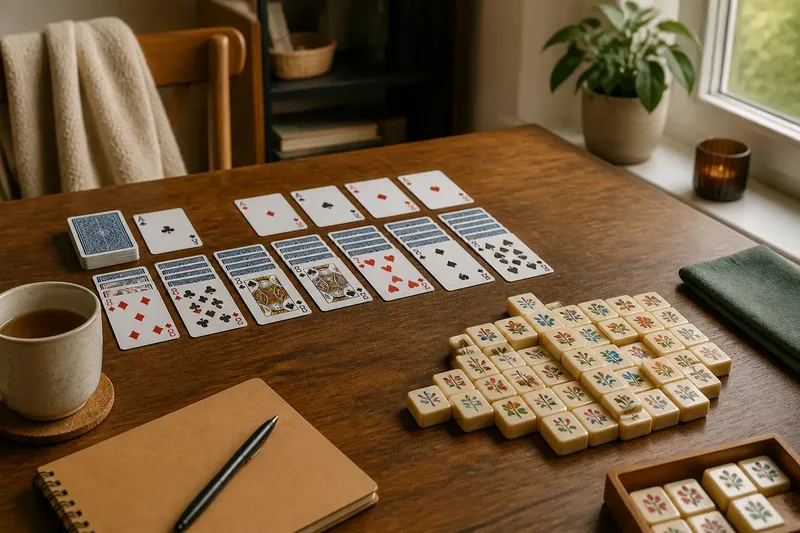
Should you choose cards or a tile game for a solo break? The answer depends on the particular game, the space you can leave set up and the kind of decisions you want to make. A game of Klondike patience, for instance, asks you to manage a changing card layout; a compact tile-matching puzzle asks you to compare pieces and placements.
Compare the actual setup and storage
With a standard deck and Klondike patience, you shuffle, deal cards into columns and leave the remaining pack nearby. The layout needs enough clear space for the columns to spread, but the cards can be gathered into one pack when you finish.
A tile game varies more from set to set. A small matching puzzle might use a limited group of tiles arranged close together, while another game may need a larger board or separate pieces. Check the instructions for the starting layout and storage method before choosing it for a short pause.
Look at what you must do after play, too. If a card layout is easy to collect but a tile set requires sorting pieces into labelled sections, the latter may suit a session you can finish without rushing better than one squeezed between chores.
Choose by the game’s real setup and reset, not by its pieces alone.
Notice how each game creates its puzzle
In Klondike patience, the available moves change as cards are revealed and moved between columns. You are weighing a sequence of choices, such as whether to uncover a face-down card or move a card to a foundation pile when the rules allow it.
In a tile-matching game, the puzzle depends on its rules. Some games ask you to match symbols or colours; others ask you to build a pattern or fit shapes into a defined space. The important comparison is not “cards versus tiles” in general, but what the specific game asks you to notice and decide.
If you want to compare options, read a short rules summary and inspect a sample layout. You should be able to tell whether play centres on ordering, matching, spatial planning or another kind of choice.
Choose a game that fits your available attention
A familiar card game can be easy to begin because you already know its rules, but the choices may still require concentration. A tile puzzle can be straightforward if it has one clear matching rule, or demanding if every placement affects several later options.
Think about what you want from the pause. If you would rather follow a known routine, choose a game whose rules you can recall. If you want to inspect a visible arrangement and compare possible fits, choose a tile puzzle that makes those decisions clear.
Say you have a clear corner of a kitchen table and a quiet spell before starting another task. You choose a small tile puzzle whose instructions say to pair matching symbols, spread the tiles within reach, and scan for pairs; when you find one, you remove it and check the remaining layout. If a household interruption comes, you can leave the visible arrangement in place only if the table will stay undisturbed; otherwise, gather the tiles and return to the puzzle later. The choice balances a hands-on puzzle against the risk of losing its layout.
Use these checks to make a quick choice
Before you take a game out, check the details that affect whether it will fit the break. Each observation points to a practical choice, with an alternative if the first option does not suit.
- Check the free surface: if the card layout fits without covering something you need, choose it; if not, choose a tile game with a smaller stated layout or wait until the surface is clear.
- Check the setup instructions: if the game needs only a shuffle and deal, use it for a brief pause; if it needs several pieces arranged first, save it for a longer, less interrupted session.
- Check how familiar the rules are: if you can recall the next legal move, begin; if not, keep the rules nearby or choose a game you already know.
- Check how the game pauses: if the layout can stay safely in place, leave it ready to resume; if the surface may be needed, take a quick note of the position or choose a game that packs away easily.
- Check the reset instructions: if pieces can be gathered without sorting, choose the game when you need a quick finish; if they must be separated into groups, play when you have time to put them away carefully.
- Check the kind of decision you want: if you want to follow a sequence, choose a card game such as Klondike; if you want to compare symbols or placements, choose a tile puzzle with those rules.
A useful rule of thumb is to favour the game whose final move and tidy-up are both easy to picture.
What should you check before choosing?
Can you play patience alone?
Yes. Patience is a family of solo card games, and Klondike is one familiar version played with a standard deck. Check the version’s rules, since layouts and legal moves differ between games.
Are tile games always harder than card games?
No. The difficulty comes from a particular game’s rules and decisions, not from whether it uses cards or tiles. A simple tile-matching game may be easier to follow than a card game with several sequences to track.
What if you have little table space?
Check the layout shown in the rules rather than guessing from the box. Choose whichever game fits the clear surface you have, and avoid starting a layout that would block a household task.
How can you avoid learning rules during a short break?
Choose a game you already know, or read the rules before setting out the pieces. A small reference card beside the deck or tile tray can help you check a move without searching for instructions.
Let the specific game decide
Cards or a tile game can both suit a solo break, but their pieces do not determine the experience on their own. Compare the named game’s layout, rules, pause point and reset; those details tell you whether it suits your room and attention better than a general claim about cards or tiles.
When you next choose cards or a tile game for a solo break, picture the first move and the moment you stop. If both are manageable with the space and time you have, pick the game whose decisions sound more appealing today.