The Hobby-Supply Pile Is Not the Hobby
A small hobby trial helps you judge the activity before buying a full kit, so you can choose materials that suit the work you actually want to do.
How can you tell whether a hobby suits you before buying a full kit? A small hobby trial lets you experience the activity first, including its setup, pace and less polished moments. That gives you a better basis for deciding what, if anything, to add to your collection.
A pastime can look appealing from the finished objects alone. The making may involve motions you have not tried, a level of concentration you did not expect, or preparation that takes more effort than the activity itself. A brief, representative session makes those parts visible without asking you to commit to a large collection of supplies.
Choose a trial that exposes the real activity
Start by asking what draws you to the hobby. Is it the repeated hand movement, solving a small design problem, learning a technique or making something useful? Your answer helps you choose an activity that reveals more than the appearance of a finished piece.
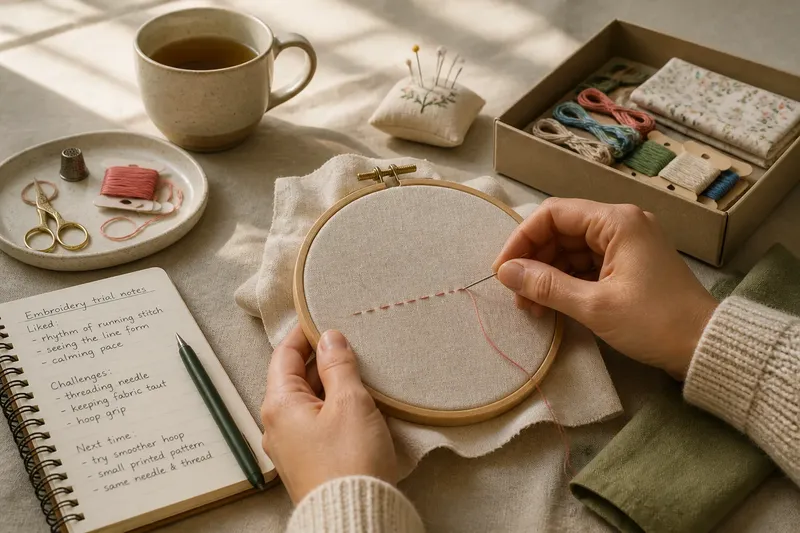
Imagine Rowan is curious about hand embroidery after seeing examples in a library book. Rather than ordering a complete kit, Rowan borrows a hoop and blunt-ended needle from a neighbour, uses scrap cotton and selects one thread from a household sewing tin. The aim is simply to try a short line of running stitch, not to produce a decoration.
Rowan finds that the repeated movement feels calming, while threading the needle and keeping the fabric taut require patience. The uneven stitches are less important than those observations: the pace appeals, but clearer instruction and a more comfortable hoop might make practice easier. Rowan now has a specific question for a future session instead of a vague impression of embroidery.
Make the first session easy to begin and assess
A useful trial has a modest scope and a clear stopping point. For watercolour, it might be mixing two colours and painting a few simple shapes; for mending, it could be sewing one loose button back onto a garment. Choose materials suitable for the task, even if they are borrowed or already at home.
Before starting, decide what you want to notice. Use these checks to keep the trial focused:
- Check your main curiosity: If you want to test the hand movements, choose a sample that uses those movements; if you are mainly curious about the social side, look for a group session instead.
- Check the result you expect: If a small sample will answer your question, use that; if the hobby only makes sense through a longer process, choose one manageable stage rather than planning a large finished project.
- Check whether the materials fit the task: If a household substitute works appropriately, use it; if it makes the activity frustrating or unsuitable, borrow or obtain a basic proper tool.
- Check how much preparation is involved: If setup feels manageable, proceed with the trial; if it takes over the session, simplify the materials or choose a more contained activity.
- Check what happens during tidying: If putting things away feels straightforward, note the setup that worked; if it becomes an obstacle, try a simpler way to keep the materials together next time.
- Check your response to the process, not just the result: If the activity remains enjoyable despite an imperfect outcome, consider another session; if the process itself feels unrewarding, pause or try a different pastime.
Keep the trial representative rather than deliberately difficult. A poor fit between the task and its tools can obscure whether you like the activity at all.
Use observations to choose what happens next
After the session, write down a few concrete details: what held your attention, what interrupted it and what you would change. “I liked seeing the line form” points towards another small embroidery project; “I kept struggling to hold the hoop” suggests that comfort, rather than a larger assortment of thread, is the issue to investigate.
Say Rowan wants to give embroidery another try. Rowan borrows a hoop with a smoother adjustment, chooses a small printed pattern and uses the same needle and thread as before. If the fabric is easier to hold and the stitching becomes more absorbing, Rowan can look for the specific materials needed to continue; if the session still feels tedious, there is little reason to buy a broad kit.
This is also a useful point to distinguish dislike of a tool from dislike of a pastime. A single awkward tool may be replaceable or borrowable. If the central activity is what feels dull, buying more accessories is unlikely to answer that question.
Let repeated use shape a small collection
A collection can support a pastime once you know what you use and why. A suitable needle, a chosen thread colour or a case that protects a tool may solve a problem that actually arose. Optional extras are easier to judge after a specific project gives them a purpose.
For Rowan, the next purchase might be a small piece of fabric and the thread required by the selected pattern. Decorative extras can wait until Rowan knows they would be useful. Keeping a few materials together in a shallow box or divided pouch can also make a later session easier to start, without letting supplies take over a shared surface.
What should you know before trying a hobby?
What if the hobby needs specialised tools?
Look for a library resource, beginner class, community group or borrowing option that lets you handle the essential tool. If none is available, consider only the basic tool needed to try the central activity, rather than buying a set of optional accessories.
How long should a first trial last?
Make it long enough to experience the main activity and its ordinary setup, but contained enough to begin without elaborate preparation. A self-contained sample can answer a useful question even if you do not finish a larger project.
What if the first result looks poor?
Notice whether you enjoyed the process despite the result. Uneven stitches or clumsy shapes do not rule out a pastime if practising felt satisfying; a polished outcome may not help if the activity itself felt unrewarding.
When does a complete kit make sense?
A kit may suit you when you have selected a particular project and its contents match what that project needs. Check the contents against the materials you already own, and distinguish essential items from optional additions.
How can you make the next decision concrete?
Imagine Rowan has a scrap of cotton, one needle, a hoop and a thread, and wants to know whether embroidery is enjoyable enough to continue. Rowan chooses a short running-stitch line, spends the session noticing the motion and fabric tension, then writes down two observations: the repeated stitching was calming, but holding the hoop was awkward. The resulting decision is to borrow a more comfortable hoop and try one small pattern before buying project-specific fabric; if that change does not make the activity more appealing, Rowan can stop without being left with an unused kit.
A small hobby trial is useful because it turns a broad decision into a specific one: continue, adjust one part of the experience or leave the idea for another time. When you do consider another purchase, return to the main search phrase—small hobby trial—and ask whether the item supports an activity you have already chosen to try.