The Pocket Notebook Before the Phone: A Brief History of Capturing Ideas
Learn how pocket notebooks developed from practical record books into spaces for sketches and stray thoughts, and choose a format that suits your habits.
The pocket notebook history is visible in the objects themselves: a ruled page for an address, a blank leaf for a sketch, or a small book kept near the door for errands. Rather than following a single path from account book to personal journal, these formats have served practical and creative purposes side by side.
Pocket notebook history has several overlapping strands
Small books have long been useful for carrying written information, but the phrase “pocket notebook” can describe different objects across periods and places. A bound memorandum book, a tradesperson’s account book and a modern pocket journal may share a compact format without having the same purpose or history.
That distinction matters because there is no simple, well-documented sequence in which one kind of notebook replaced another. Paper availability, printing, binding, literacy and local habits all shaped what people carried. Without a specific period or surviving object to discuss, broad claims about who used the earliest pocket notebooks risk sounding more certain than the evidence permits.
A careful history therefore starts with what can be seen: the book’s size, page ruling, printed sections and signs of use. These details can suggest whether it was designed for accounts, addresses, appointments, sketches or open-ended notes, though the owner might have used it differently.
Printed layouts offered different ways to keep notes
Blank pages leave the purpose open; ruled pages help keep handwriting aligned; pre-printed sections guide a particular kind of record. Calendars, address spaces and labelled headings are useful when a reader wants information to be easy to locate, while an unstructured page accommodates an unexpected thought or drawing.
These designs should not be treated as a neat historical ladder from practical records to personal expression. A printed address book could sit alongside a blank notebook, and a book intended for work might also collect observations. The format offered a set of possibilities, not a fixed account of its owner’s inner life.
For a homebody choosing a notebook now, the same distinction is practical: pick ruled pages for lists, blank pages for sketching, or a mixed layout if you move between both.
Everyday notes could mix errands with observation
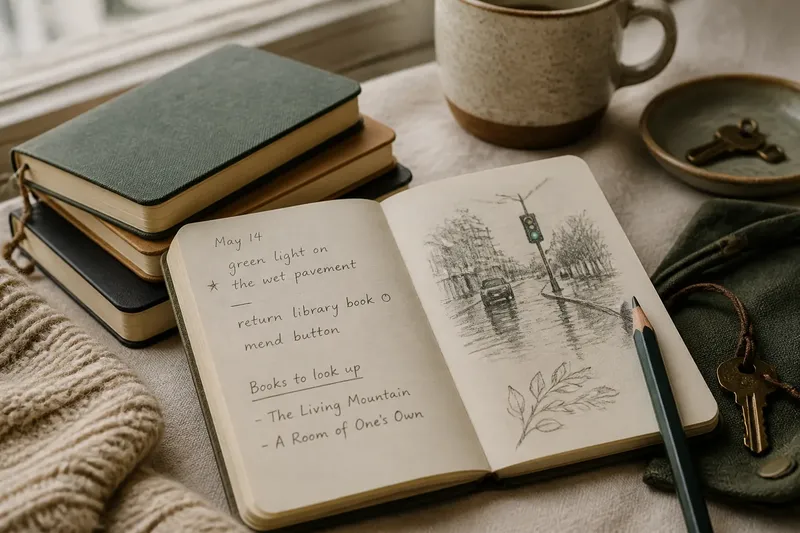
A compact book is suited to information that is useful in passing: a title to look up, a reminder to mend a button, or a detail noticed on a walk. Putting different kinds of notes together is not a failure of organisation. It reflects how attention shifts between practical tasks and curiosity.
Imagine a reader sitting by a window with a blank pocket notebook and a pencil. They write “green light on the wet pavement” after watching the rain, then add “return library book” beneath it; later, the first line may prompt a sketch, while the second serves as a reminder. The result is a page with two different jobs, neither of which needed a separate system.
Paper and phones suit different kinds of remembering
A phone can store photographs, voice notes and searchable text, while a notebook offers a direct surface for handwriting, arrows and rough diagrams. Neither tool is inherently better for every purpose. A photograph helps preserve exact visual detail; a quick paper sketch can show what caught your attention, even if it is not a faithful copy.
The choice can follow the note. Use a phone for information you need to search or share, and paper for a thought you want to shape by hand. Keeping the notebook beside a favourite chair or near the front door can make it easy to reach without turning the habit into a project.
What should you look for in a pocket notebook?
Are blank pages or ruled pages better?
Blank pages suit free sketches and layouts, while ruled pages help with readable lists and longer notes. If you expect to do both, a mixed format or a plain notebook with a pencil guide may be more comfortable.
Should a pocket notebook have a dated layout?
Dated pages help organise notes by day, but can make unused pages feel like gaps in a record. Choose undated pages if you want to write irregularly without keeping up with a calendar.
What belongs in a pocket notebook?
Use it for reminders, observations, book titles, questions or rough drawings—whatever you want to keep within reach. Avoid putting sensitive information in a notebook you could lose, and keep essential reminders in a system you check reliably.
How can you keep mixed notes easy to find?
Give a page a simple heading, add a symbol beside reminders, or use a folded corner for something to revisit. If you rarely need to search old notes, leaving pages in date order may be enough.
A small notebook works best when its purpose stays flexible
Pocket notebook history is not a story of one format acquiring a single meaning. Compact books have accommodated records, reminders and observations, while their layouts have varied according to makers’ choices and owners’ habits. Their continuing appeal is that one page can serve a practical purpose and a playful one without forcing either to become a finished project.
Start with the kind of note you most often wish you had kept. If it is a list, choose clear ruling; if it is a sketch, leave room to draw; if it changes from day to day, an undated mixed page may fit. The most useful notebook is the one whose pages make it easy to return to the small details you chose to save.